The Big Book on the Shelf That Knew Everything: Growing Up With the Family Encyclopedia
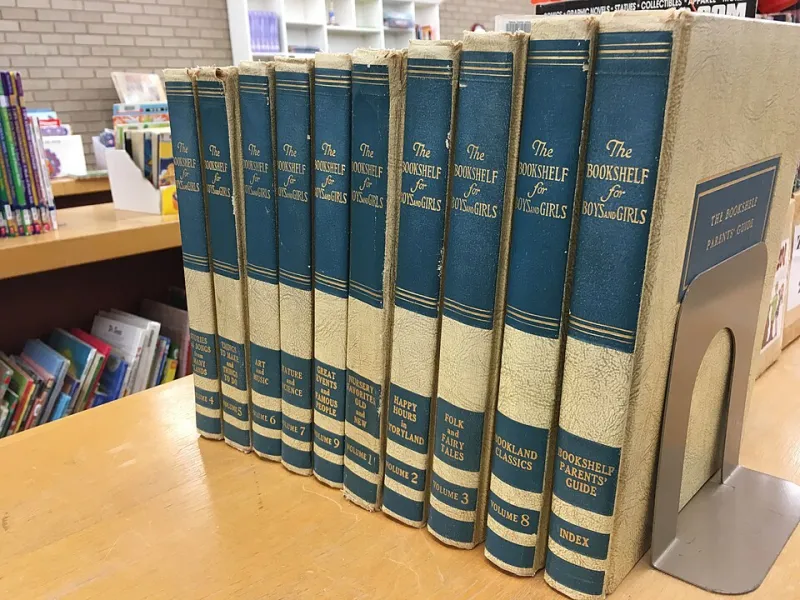
Photo: Texas State Library and Archives Commission from Austin, TX, United States, CC BY 2.0, via Wikimedia Commons
There's a particular smell that anyone who grew up in an American home before the mid-1990s probably remembers without being able to name it. It was the smell of the encyclopedia — that faintly dusty, slightly waxy combination of thick coated paper and binding glue that hit you the moment you pulled a volume off the shelf.
For decades, that smell meant you were about to find out something.
A Purchase That Meant Something
Buying a set of encyclopedias wasn't a casual decision. A full set of World Book or Encyclopædia Britannica cost the equivalent of several hundred dollars — sometimes more than a thousand — and many families bought them on installment plans, paying monthly the same way they'd pay off a refrigerator or a television set.
Think about what that meant. Parents were literally financing knowledge for their children. They were making a monthly financial commitment to the idea that their kids should have access to information. The encyclopedia salesman — and there really was such a person, who came to your door with a briefcase and a pitch — understood exactly how to frame that decision. He wasn't selling books. He was selling the future your children deserved.
And it worked. By the mid-20th century, an estimated 80 percent of American school-age children had access to a home encyclopedia set. The bookshelf in the living room or den, lined with matching spines in burgundy or navy or forest green, became one of the defining images of the aspirational American household.
The Art of Looking Something Up
Here's what the experience actually looked like. Your kid brother insists that the Amazon River is longer than the Nile. Your dad thinks otherwise. Nobody's going to pull out a phone. Someone gets up, walks to the shelf, and pulls Volume A or Volume N depending on which entry you're hunting. You flip through pages that feel substantial — heavy, almost formal — until you find what you're looking for.
 Photo: Amazon River, via www.bing.com
And then, almost always, you read more than you intended to.
That was the secret power of the physical encyclopedia. It was a rabbit hole before rabbit holes had a name. You looked up the Amazon, and your eye caught an entry about the Amazon basin's indigenous tribes, and fifteen minutes later you were three entries deep into something you never planned to read. The physical layout of the page — the cross-references printed in bold, the photographs tucked between columns of text — made wandering feel natural.
The internet can technically do the same thing. But there's a difference between clicking a hyperlink on a screen and turning a physical page, between a Wikipedia tab and a volume that has weight in your hands.
Homework Had a Different Texture
For kids growing up in the 1950s through the 1980s, the encyclopedia was central to the homework experience in a way that's genuinely hard to explain to anyone under 30. When your teacher assigned a report on the water cycle, or the Civil War, or the solar system, you didn't open a browser. You opened Volume W, Volume C, or Volume S.
What you got wasn't infinite. The encyclopedia had edges. It contained what it contained, and everything was written by actual experts who'd been hired specifically to make complex subjects accessible to a general audience. The information was curated, edited, and fact-checked before it ever reached your shelf.
That constraint was also a kind of gift. You couldn't get lost in an overwhelming flood of contradictory sources. You read what was there, took notes by hand, and formed your understanding from a fixed and reliable foundation. Whether that made for better or worse learning than today's open-ended research is a genuinely interesting question.
When the Yearbook Arrived
One detail that often gets forgotten: most encyclopedia sets included annual yearbooks — supplementary volumes that arrived in the mail each year to update the main set with the previous year's major events. Families would add them to the shelf, keeping their collection current.
There was something almost ceremonial about the arrival of the new yearbook. It meant the world had moved forward and your shelf had kept pace. Kids would flip through it the way people scroll through news feeds today — looking for what had changed, what had happened, what was new.
The Day the Screen Replaced the Shelf
Encarta arrived on CD-ROM in 1993 and the writing was on the wall almost immediately. By 2001, World Book had moved primarily to digital formats. Britannica printed its last physical edition in 2012 after 244 years — a moment that passed with surprisingly little public mourning, given how central those books had been to American family life for generations.
The internet didn't just replace the encyclopedia. It replaced the entire idea that knowledge lived in a specific, trustworthy place. Today, any answer is available in seconds — but so is any wrong answer, any half-truth, any confident-sounding nonsense dressed up in authoritative language. The encyclopedia was never perfect, but it had editors, standards, and accountability. The modern information landscape has all three of those things in some places and none of them in others, and the difference isn't always obvious.
What That Shelf Was Really Saying
Looking back, the family encyclopedia was about more than information. It was a physical declaration that a household valued learning — that knowledge was worth budgeting for, worth displaying, worth the monthly payment. Those matching spines on the living room shelf told every visitor something about who you were.
We still value knowledge, of course. But today it's invisible, weightless, stored in clouds and accessed through glass. There's nothing to put on a shelf. Nothing to hand down to your kids when they move out.
Somewhere in the gap between those two worlds — between the encyclopedia you could hold and the search bar you type into — something about the relationship between Americans and their information quietly shifted. Whether we got a better deal in the exchange is a question worth sitting with.