One Page, One Envelope, One Shot: How College Admissions Became a Years-Long Obstacle Course

Picture a high school senior in 1958. It's October. He sits down at the kitchen table, fills out a one-page form — name, grades, a teacher's reference, maybe a short paragraph about himself — folds it into an envelope, licks a stamp, and drops it in the mailbox. Done. Application submitted. He goes back to football practice.
Now picture a high school senior today. It's October — but she's been preparing since eighth grade. She has a college counselor, a test prep tutor, a list of extracurriculars carefully chosen to tell a coherent "narrative," and a folder of essay drafts that her parents have read seventeen times. She's managing five different platforms, tracking deadlines across twelve schools, and worrying whether her activities section looks "authentic enough."
Same milestone. Completely different world.
When the Application Fit on a Single Page
For most of the mid-twentieth century, applying to college was a straightforward administrative task. Schools wanted to know who you were, where you went to school, and what your grades looked like. Standardized tests existed — the SAT was introduced in 1926 — but they weren't the obsessive focal point they'd later become. A letter of recommendation from a teacher or local figure carried real weight, and personal essays, if required at all, were brief and unpretentious.
Many state schools asked for little more than proof of high school graduation. Even elite universities operated with a fraction of today's application volume. Harvard received around 3,000 applications in 1960. By 2023, that number had climbed past 56,000. The math alone tells you something changed dramatically — and it wasn't just population growth.
The process was also genuinely local. Admissions officers visited high schools in their region. They knew guidance counselors by name. Decisions were made by people who understood the context of your community, your school, your particular circumstances. It wasn't perfect — access was deeply unequal in ways that shouldn't be romanticized — but the mechanics of applying were not themselves a barrier.
How the Machine Got Built
The shift didn't happen overnight. Through the 1970s and 1980s, college admissions grew more competitive as a larger share of Americans pursued degrees and universities began competing for rankings and reputation. The U.S. News & World Report college rankings, launched in 1983, changed everything. Suddenly, acceptance rates became a metric of prestige. Lower acceptance rates meant higher rankings. Higher rankings meant more applications. More applications meant lower acceptance rates. The feedback loop was merciless.
By the 1990s, the Common Application had arrived — originally designed to simplify the process by letting students apply to multiple schools with one form. In practice, it accelerated the volume of applications and gave schools a reason to add more requirements to differentiate themselves. Supplemental essays multiplied. Activity lists expanded. Portfolios, interviews, demonstrated interest, and legacy status all entered the equation.
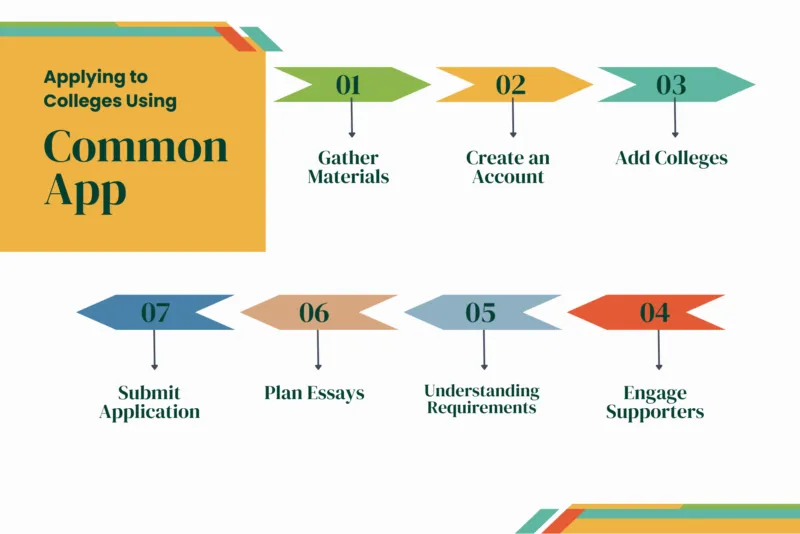 Photo: Common Application, via ccplonline.org
The college consulting industry quietly exploded alongside all of this. What started as informal guidance from high school counselors became a full-fledged private market. Today, independent college counselors charge anywhere from $150 an hour to $10,000 or more for comprehensive packages. Families in wealthy zip codes begin strategizing in middle school. Families without resources navigate the maze alone — and the outcomes reflect that disparity.
The Hidden Cost Before the Tuition Bill
Here's what rarely gets discussed: the cost of applying has become significant before a single dollar of tuition is paid. Application fees alone — typically $50 to $90 per school — add up fast when students are advised to apply to ten, twelve, or fifteen schools to improve their odds. Test prep courses run hundreds to thousands of dollars. SAT and ACT retakes cost money. Visiting campuses costs money. And if you hire a private counselor, you're looking at an investment that rivals a semester's worth of books.
The emotional cost is harder to quantify but just as real. Anxiety around college admissions has become a defining feature of American adolescence in a way that simply didn't exist fifty years ago. High school students report stress levels that rival working adults, and college counselors — both school-based and private — describe a process that feels less like an educational transition and more like a corporate recruitment gauntlet.
What Got Lost in the Complexity
There's something worth sitting with here. The original purpose of a college application was to help an institution understand whether a student was ready and willing to learn. It was a conversation starter, not a performance. Somewhere along the way, the application became its own genre — a curated, polished, strategically assembled product designed to appeal to an algorithm and a committee simultaneously.
The students who thrive in this environment aren't necessarily the most intellectually curious or capable. They're often the ones with the most resources, the most coaching, and the most time to dedicate to the performance of being an ideal applicant. That's a strange thing to optimize for.
Some schools are pushing back. The test-optional movement, which gained major momentum during the COVID-19 pandemic, has prompted genuine debate about what admissions data actually predicts. A handful of elite universities have experimented with lottery systems among qualified applicants. Community colleges and trade programs — for decades treated as consolation prizes — are getting a second look as the return on investment of four-year degrees gets harder to justify.
The Vault of Change Perspective
The story of college admissions is, at its core, a story about what happens when competition replaces clarity. A process designed to open doors gradually became one that filters people before they even reach the threshold.
That one-page form from 1958 wasn't a golden era — plenty of Americans were shut out of higher education entirely by forces far more unjust than a supplemental essay. But the mechanical simplicity of that application reflected something worth remembering: the idea that a young person's potential shouldn't require a professional translator to be legible.
We've built something remarkably complicated in its place. Whether it's actually better at finding the right students for the right schools is a question worth asking — loudly, and often.