Lost Without a Map and Completely Fine With It: America Before GPS
Lost Without a Map and Completely Fine With It: America Before GPS
Picture this: you're somewhere in rural Ohio in 1987. You've taken a wrong turn — maybe two — and the last town you passed through was forty minutes ago. Your paper map is folded incorrectly, which means the section you need is hidden in a crease you can't flatten without pulling over. Your passenger is holding it at an angle that makes no sense. You're mildly irritated at each other. You're also, genuinely and completely, lost.
There's no app to open. No voice to correct you. No little blue dot showing exactly where you are relative to everything else. Just the road, the map, and whatever local knowledge you can extract from the next gas station you find.
For most of American history, that was the whole deal.
The Paper Map Was an Art Form
Before GPS became standard in smartphones around 2007 and 2008, the road atlas was practically sacred. AAA handed them out. Gas stations sold them near the register. Glove compartments across America held a layered archive of maps from different years, different trips, different eras of someone's life.
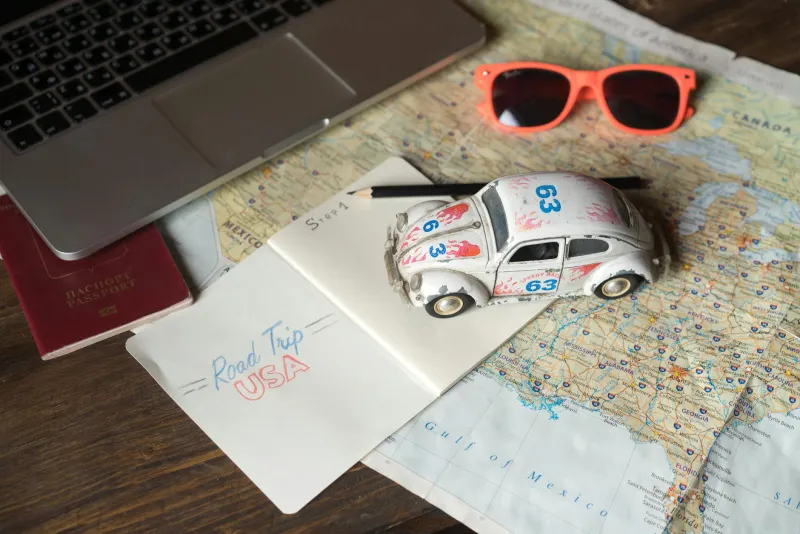
Planning a road trip meant spreading a map across the kitchen table the night before and tracing routes with your finger. You'd note the highway numbers, estimate time based on distance and speed limits, and write down the names of towns you'd pass through as a rough mental checklist. If you were organized, you'd jot the directions on a notepad. If you weren't, you memorized what you could and winged the rest.
The folded road map — that impossible accordion of paper that never quite went back to its original shape — was a navigation tool, a planning document, and occasionally a source of genuine domestic conflict. Anyone who's tried to refold a full-size state map in the passenger seat of a moving car at highway speed understands this on a cellular level.
Gas Stations Were Information Hubs
Here's something that's almost entirely disappeared: the gas station attendant who actually knew the roads. Before self-service pumps became standard in the 1980s, stopping for gas often meant a brief exchange with someone who could tell you whether the road ahead had construction, which shortcut locals used, or whether the bridge on Route 9 was still washed out from last spring.
Asking for directions was a social skill. It required some humility, a willingness to listen carefully, and the ability to translate "go past the old Miller farm, you'll see a water tower, take the second left after that" into something actionable. It wasn't always reliable. But it was human.
The AAA TripTik — a spiral-bound set of custom strip maps mailed to members before a long trip — was considered premium navigation technology in its time. You flipped the pages as you drove, following a highlighted route through a series of zoomed-in segments. It was methodical, careful, and required actual pre-planning in a way that opening Google Maps never does.
Being Lost Was a Different Kind of Experience
The anxiety of being genuinely lost before GPS was real — but so was the problem-solving that came with it. You had to think spatially. You had to remember landmarks. You had to reconstruct your route mentally and figure out where you'd gone wrong. Getting unlost required active engagement with your environment in a way that "recalculating" simply doesn't.
Research in cognitive science over the past decade has consistently found that people who rely heavily on GPS navigation show reduced activity in the hippocampus — the part of the brain associated with spatial memory and navigation. A 2020 study from University College London found that city dwellers who used GPS regularly were less likely to develop the kind of mental mapping that comes naturally to people who navigate on their own.
In other words, we may be outsourcing not just the task of navigation, but the mental capacity for it.
What a Road Trip Used to Feel Like
There's a texture to the pre-GPS road trip that's hard to fully convey to anyone who grew up with smartphones. The uncertainty was part of the experience. You might take a wrong turn and discover a small town you'd never have found otherwise. You might stop at a diner because it was the first building you'd seen in an hour and you needed to ask someone if you were still heading the right way.
Serendipity was built into the structure of travel in a way it no longer is. When every route is optimized and every detour is instantly corrected, you lose the productive chaos of getting a little lost.
Not everyone romanticizes this, and fairly so. Getting lost in an unfamiliar city at night, or missing an exit on a deadline, or trying to navigate a complicated interchange with a toddler in the back seat — none of that was charming. The efficiency of GPS navigation is genuinely valuable and has almost certainly reduced accidents caused by distracted map-reading while driving.
The Navigation We Carry Now
Today, the average American spends very little time thinking about navigation as a skill. Turn-by-turn directions are so embedded in daily life that many drivers couldn't describe the route between two places they've driven dozens of times. The journey has become almost entirely automatic.
GPS has also changed how we explore. When every destination is a search away and every route is pre-calculated, the act of wandering — of driving somewhere without a fixed plan and seeing what you find — requires a deliberate choice to put the phone down. It's no longer the default.
The Vault Perspective
The shift from paper maps to satellite navigation happened fast enough that many Americans lived through both worlds. And the contrast is significant: not just in convenience, but in the relationship between traveler and place. Getting somewhere used to require you to understand, at least roughly, where you were. Now it doesn't.
That's progress, clearly. But it's also a quiet trade — spatial awareness and navigational confidence exchanged for frictionless efficiency. Whether that's a fair deal probably depends on how much you value the kind of thinking that only happens when you're a little bit lost.